
Tirzepatide vs. Semaglutide: Which GLP-1 Is Right for You?

Quick answer: Tirzepatide and semaglutide are both once-weekly injectable medications that help regulate appetite and support weight loss. The key difference is that semaglutide activates one receptor (GLP-1), while tirzepatide activates two (GIP + GLP-1). In the only large head-to-head trial, adults on tirzepatide lost an average of 20.2% of their body weight over 72 weeks versus 13.7% on semaglutide. Semaglutide has a longer track record, costs less, and remains an excellent option for many people. The right choice depends on your goals, health history, budget, and a licensed clinician's evaluation.
If you've been reading about GLP-1s, you've probably landed on the same question everyone eventually asks: tirzepatide or semaglutide?
They get mentioned in the same breath. They're both weekly injections. They both show up in group chats, headlines, and telehealth ads. But they are not the same medication, and the differences matter when you're deciding where to start.
This guide walks through how each one works, what the research actually shows, how side effects and cost compare, and how to think about which pathway fits your life. If you want the fundamentals first, start with our beginner's guide to GLP-1s and come back.
How semaglutide works
Semaglutide mimics GLP-1 (glucagon-like peptide-1), a hormone your gut releases after you eat. When it activates GLP-1 receptors, it does a few useful things at once: it signals fullness to your brain, slows how quickly your stomach empties, and helps your pancreas release insulin in response to food. The net effect is that you feel satisfied sooner, stay satisfied longer, and tend to eat less without white-knuckling it.
Semaglutide has been prescribed in the U.S. since 2017 for type 2 diabetes and since 2021 for chronic weight management, so it has the longest safety record of any modern GLP-1. It's also the more affordable of the two, which is why it's still the starting point many clinicians recommend.
How tirzepatide works
Tirzepatide does everything semaglutide does, and then adds a second pathway. In addition to GLP-1, it activates GIP (glucose-dependent insulinotropic polypeptide) receptors. GIP is another gut hormone involved in insulin signaling and how the body handles fat and energy. Researchers believe the two pathways working together explain why tirzepatide tends to produce greater weight loss and, interestingly, somewhat fewer stomach-related dropouts in trials.
That "dual agonist" design is the single most important difference between the two medications. It's why you'll see tirzepatide described as GIP + GLP-1 while semaglutide is described simply as GLP-1.
Which works better for weight loss?
For years, the honest answer was "we can only compare across separate trials." That changed in 2025 when the results of SURMOUNT-5 were published in The New England Journal of Medicine, the first large randomized trial to put the two medications head-to-head in adults with obesity who did not have diabetes.
Over 72 weeks, with 751 participants:
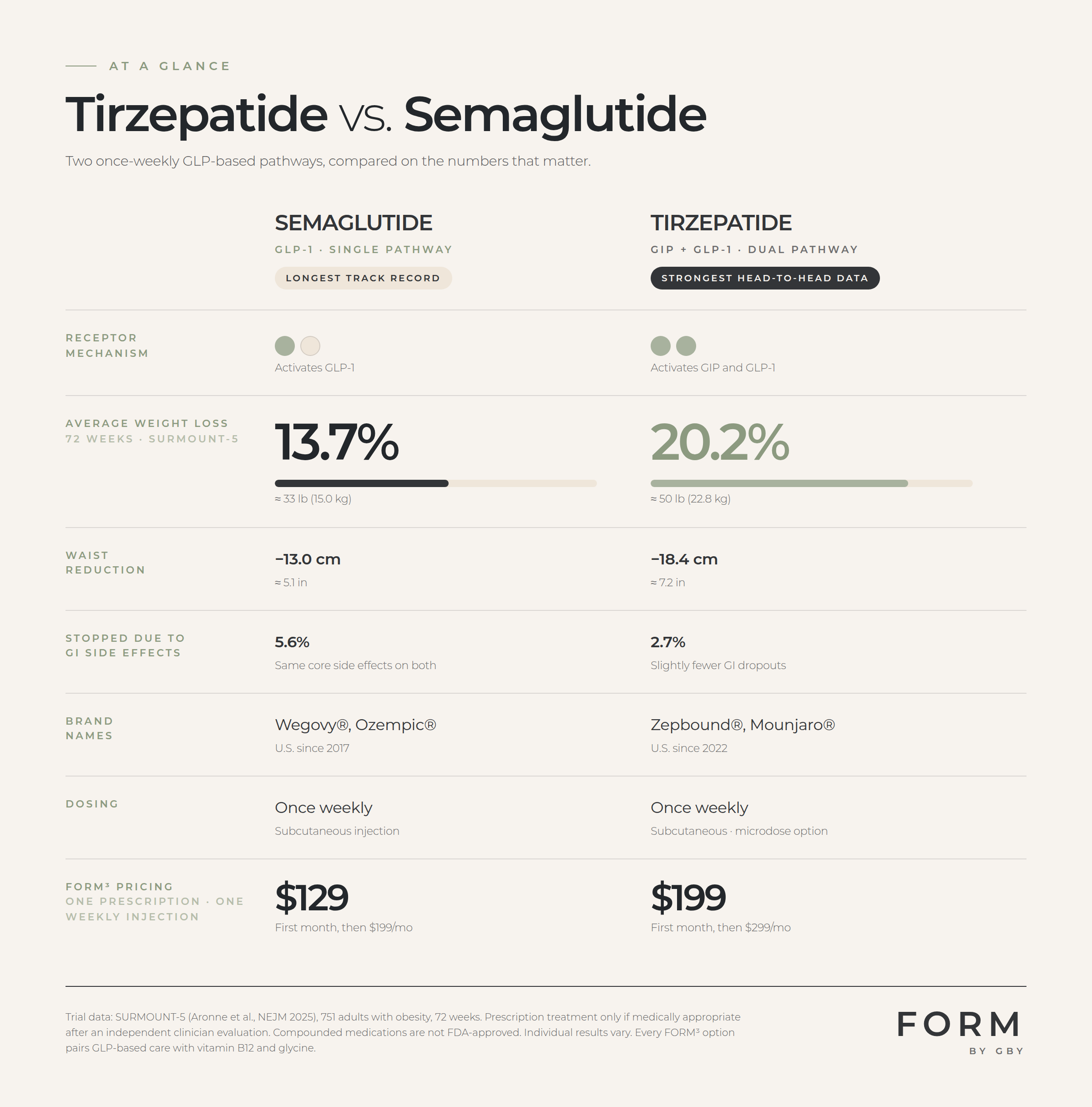
Tirzepatide (10 mg or 15 mg): average weight loss of 20.2%, about 22.8 kg (50 lb)
Semaglutide (1.7 mg or 2.4 mg): average weight loss of 13.7%, about 15.0 kg (33 lb)
Tirzepatide also produced a larger reduction in waist circumference (18.4 cm vs 13.0 cm), and more participants on tirzepatide hit the higher milestones of 15%, 20%, and 25% total body weight lost.
So does that make tirzepatide "better"? For average weight loss, yes, the data are clear. But "better" for you is a different question. Semaglutide still delivered nearly 14% average weight loss, which is life-changing for most people. It costs less. It has more years of real-world safety data. And plenty of people respond beautifully to it. A 6.5-percentage-point difference in a trial average is meaningful, but it's not the only thing that should drive your decision.
Side effects: semaglutide vs. tirzepatide
Both medications share the same core side-effect profile because they share the GLP-1 pathway. The most common effects are gastrointestinal: nausea, constipation, diarrhea, reduced appetite, and occasional reflux or fatigue, especially during the first few weeks and after each dose increase.
Two things are worth knowing from the head-to-head data. First, side effects were broadly similar in type and frequency across both groups. Second, slightly fewer people on tirzepatide stopped treatment because of GI symptoms (2.7% vs 5.6%). Some clinicians attribute that to the GIP pathway, which may take some of the edge off nausea.
Either way, most side effects are dose-dependent and manageable. This is exactly why clinician guidance matters: a licensed provider titrates your dose gradually, adjusts the schedule if you're struggling, and knows when a symptom is normal versus when it needs attention.
Both medications carry the same boxed warning regarding thyroid C-cell tumors seen in rodent studies, and neither is appropriate for people with a personal or family history of medullary thyroid carcinoma or MEN 2. Your intake covers this.
Cost: tirzepatide vs. semaglutide
Cost is often the deciding factor, and it's a fair one.
Brand-name Wegovy® and Zepbound® typically run over $1,000 per month at list price, with actual cost depending heavily on insurance coverage and manufacturer programs. Semaglutide is generally the less expensive molecule in every format.
At FORM by GBY, clinician-guided compounded programs are priced transparently, with no insurance required:
Semaglutide FORM³ — $129 for your first month, then $199/month
Tirzepatide FORM³ — $199 for your first month, then $299/month
Microdose Tirzepatide FORM³ — $199 for your first month, then $299/month
Every FORM³ option is one compounded prescription, administered as one weekly injection when prescribed, that pairs GLP-based metabolic care with vitamin B12 and glycine. We also offer Wegovy® and Zepbound® memberships for people who prefer the brand-name route. Read more about how FORM³ is designed in Meet FORM³. We also have compounded Semaglutide and Tirzepatide available without the triple blend of vitamin B12 and Glycine if appropriate for your needs and treatment plan.
A quick note on "compounded": compounded medications are prepared by licensed U.S. pharmacies for an individual patient based on a clinician's prescription. They are not FDA-approved, and they're only prescribed when an independent clinician decides it's appropriate. If you want to understand what to look for in a compounding pharmacy, we wrote an entire guide: Your Group Chat Is Talking About Peptides. Let's Talk About the Pharmacy.
What about microdose tirzepatide?
Microdosing means starting and staying at a lower-than-standard dose under clinician direction, rather than titrating up to the maximum. People explore it for a few reasons: a smaller amount of weight to lose, wanting a gentler side-effect experience, focusing on maintenance after reaching a goal, or general appetite and metabolic support without a full-dose protocol.
It's not "tirzepatide lite" for everyone, and it's not a shortcut. It is a legitimate, clinician-directed pathway for the right person, which is why FORM offers Microdose Tirzepatide FORM³ alongside the standard option. Your provider helps you figure out whether it makes sense for your goals.
Can you switch from semaglutide to tirzepatide (or the other way)?
Yes, with clinician oversight. People switch for a few common reasons: a plateau on semaglutide, side effects they'd like to reduce, cost changes, or wanting to step down to a gentler option for maintenance. Switching isn't a simple one-to-one dose swap, so your provider will map out a transition plan and a new starting dose. If you're currently on one medication and curious about the other, mention it in your intake so the clinician can factor it in.
How to choose: a simple framework
There's no universal winner. There is a right fit for you. Here's how we'd suggest thinking through it, and what a FORM clinician will be weighing when they review your intake:
Semaglutide may be the better starting point if you're new to GLP-1s and want the most established option, you'd like to keep monthly cost lower, you have a moderate amount of weight to lose, or you simply prefer to begin with the single-pathway medication and see how your body responds.
Tirzepatide may be the better fit if you have a larger weight-loss goal, you've plateaued on semaglutide, you want the pathway with the strongest head-to-head data, or you're interested in a microdose approach for maintenance or a gentler start.
Either way, what matters most is consistency, protein, strength training, sleep, and having a clinician in your corner. The medication is a tool. The plan around it is what makes results stick. Our post on Metabolic Health 101 explains why we look beyond the number on the scale.
What happens next at FORM
Choosing between tirzepatide and semaglutide doesn't have to be a decision you make alone, and at FORM it isn't.
Complete a private online intake from your phone. It takes about ten minutes. Here's exactly what to expect.
A licensed clinician reviews your health history, goals, and any prior GLP-1 experience, and determines whether treatment is medically appropriate and which pathway fits.
If prescribed, your medication ships to you from a U.S. compounding pharmacy, with guidance on dosing and how to give yourself the injection.
Ongoing support as your dose is adjusted and your goals evolve.
Prescription treatment only if medically appropriate after an independent clinician evaluation. Completing an intake does not guarantee a prescription. Compounded medications are not FDA-approved. Individual results vary.
Frequently asked questions
Is tirzepatide stronger than semaglutide? In the SURMOUNT-5 head-to-head trial, tirzepatide produced greater average weight loss (20.2% vs 13.7% over 72 weeks) because it activates both GIP and GLP-1 receptors instead of GLP-1 alone. "Stronger" doesn't automatically mean better for every person; semaglutide remains highly effective and is often the recommended starting point.
What is the main difference between semaglutide and tirzepatide? Semaglutide acts on one hormone receptor (GLP-1). Tirzepatide acts on two (GIP and GLP-1). Both are once-weekly injections that reduce appetite and slow digestion, but tirzepatide's dual mechanism is associated with greater weight loss in clinical trials.
Which has fewer side effects, tirzepatide or semaglutide? Both share the same common GI side effects. In the head-to-head trial, fewer people discontinued tirzepatide due to GI symptoms (2.7%) than semaglutide (5.6%), though overall side-effect types and rates were similar. Gradual, clinician-guided dose increases are the best way to keep side effects manageable on either medication.
Is Zepbound the same as tirzepatide? Is Wegovy the same as semaglutide? Yes. Zepbound® and Mounjaro® are brand names for tirzepatide. Wegovy® and Ozempic® are brand names for semaglutide. Compounded versions contain the same active molecule but are prepared by a licensed pharmacy for an individual patient and are not FDA-approved.
How much does tirzepatide cost compared to semaglutide? Semaglutide is generally less expensive. At FORM by GBY, Semaglutide FORM³ is $129 for the first month then $199/month, and Tirzepatide FORM³ is $199 for the first month then $299/month. Brand-name versions typically cost significantly more without insurance.
Can I switch from semaglutide to tirzepatide? Yes, under clinician supervision. Your provider will set an appropriate starting dose for the new medication rather than swapping milligram for milligram. Mention any current or past GLP-1 use in your intake.
How do I know which one I should take? Complete a FORM intake. A licensed clinician reviews your health history, goals, and budget, and recommends the pathway that fits, whether that's semaglutide, tirzepatide, microdose tirzepatide, or a brand-name membership.
This article is for educational purposes and is not medical advice. Talk to a licensed clinician about whether GLP-1 treatment is appropriate for you. FORM by GBY compounded medications are prepared by U.S. pharmacies and are not FDA-approved. Individual results vary.