
NAD+ Injections vs. Topical vs. Sublingual: The Benefits, and What People Say It Changed
NAD+ is the coenzyme your cells use to make energy, repair DNA, and keep metabolism running, and it declines steadily from your 30s onward. Restoring it is the point of NAD+ therapy. Injections deliver the most NAD+ into your system and are what most people choose when the goal is a noticeable change in energy, recovery, and focus. Sublingual is the low-effort daily option, well suited to maintenance. Cream works locally on skin and is best treated as a skincare step, not an energy treatment. The benefits people report most consistently are steadier all-day energy, waking up feeling rested, clearer thinking, and bouncing back faster from workouts, travel, and late nights, usually within the first two to four weeks. About a third of people notice little, which is worth knowing before you start.
Here's how the three forms compare, what the benefits actually look like in daily life, and what people tend to say once they've been on it a while.
Why people are drawn to NAD+ in the first place
Most people don't come to NAD+ because of a longevity paper. They come because of a feeling: the 3 p.m. crash that coffee doesn't fix anymore, the workout recovery that takes two days instead of one, the sense that they're running the same life on a smaller battery than they had at 28. NAD+ is appealing because it's not a stimulant and not a sedative. It works upstream, at the level of cellular energy production, which is why people describe the effect as feeling more like themselves rather than feeling wired.
It also fits neatly into a broader plan. NAD+ is the "cellular energy" component in FORM Era, paired with tirzepatide and glutathione for people who want metabolic care and recovery support in one monthly routine, and it's a natural companion to sermorelin or GLP-1 paths for people who notice their energy dip while losing weight.
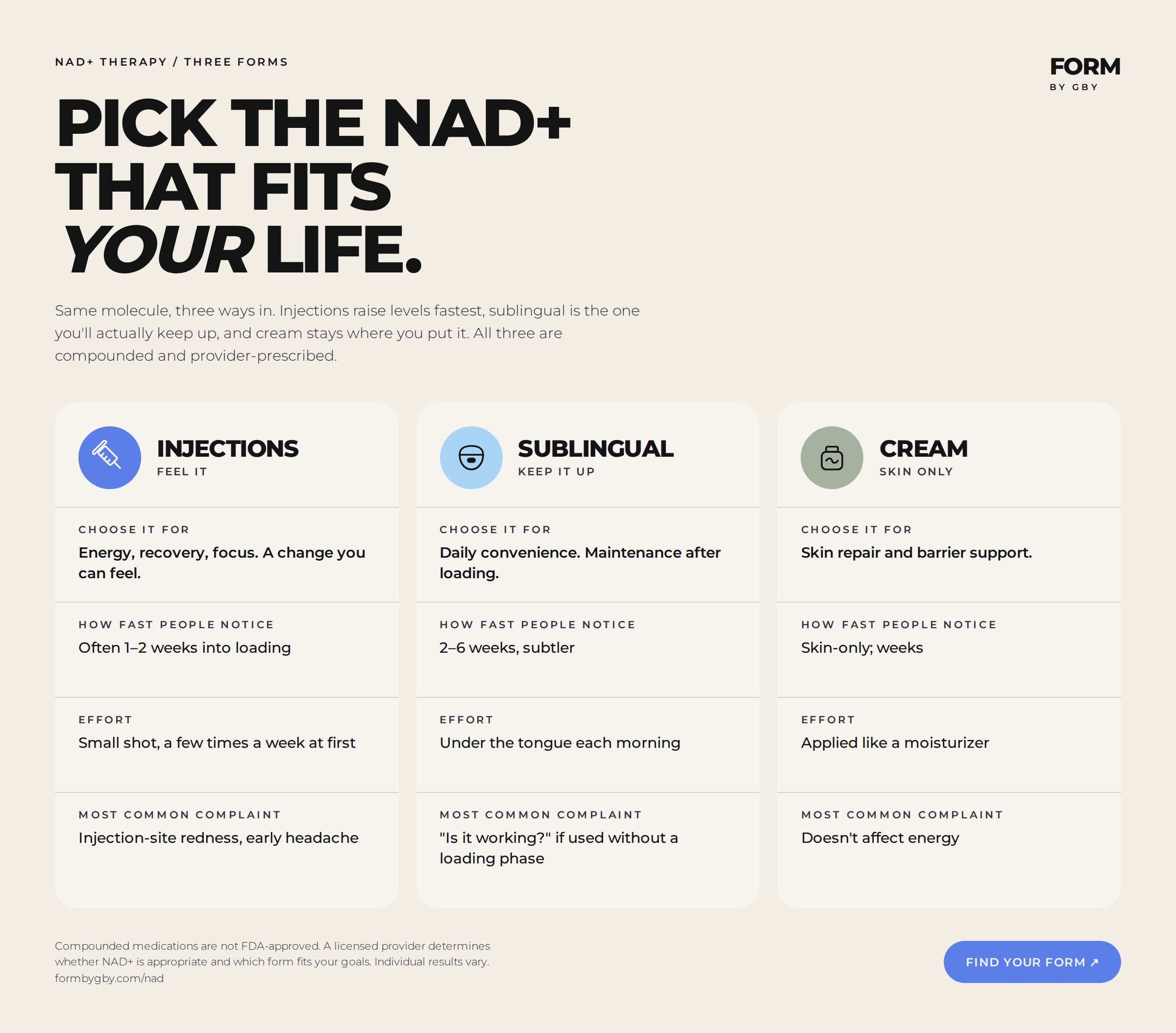
The three forms, compared on what matters day to day
Injections: the one people choose when they want to feel it
Subcutaneous NAD+ injections put the molecule directly into tissue, bypassing digestion entirely. That's why injections are the form with the most human data and the one people reach for when they want a noticeable shift. A provider-guided protocol usually starts with a loading phase, small injections several times a week for the first few weeks, then tapers to a maintenance schedule once levels are up. The injection itself is the same tiny, just-under-the-skin shot used for GLP-1s and takes under a minute; our self-injection guide covers it step by step.
What draws people: the effect tends to be the clearest and most consistent of the three, and once the loading phase is done, it's a few minutes a week. What gives people pause: it's a needle, and injection-site redness or a mild headache in the first week are common enough that your provider will mention them. Unlike IV infusions, which can cause flushing and chest tightness if run too fast, subcutaneous injections are usually uneventful.
Sublingual: the one people stick with
Sublingual NAD+ dissolves under the tongue, where the thin mucosal lining lets part of the dose absorb straight into the bloodstream instead of being broken down in the gut. It's a meaningful step up from swallowing a capsule, and it's the easiest form to build into a morning routine. No refrigeration, no prep, nothing to explain to a travel companion.
What draws people: it removes every barrier to consistency, and consistency is where NAD+ delivers. Many FORM patients start with injections to build levels and switch to sublingual to hold them. What gives people pause: the dose reaching your bloodstream depends on how long you hold it and how much gets swallowed, so the effect is gentler and less predictable than an injection. People who go straight to sublingual without a loading phase sometimes report a subtler change and wonder if it's working.
Cream: the one for your skin, not your energy
Topical NAD+ is applied like a moisturizer and acts where it lands. NAD+ has a documented role in supporting skin cell repair after UV exposure and maintaining the skin barrier, so a cream makes sense as a targeted skincare step. It won't raise whole-body NAD+ or change how you feel at 3 p.m.
What draws people: those already building a peptide skincare routine, for instance with FORM Glow Cream, often add NAD+ cream for its repair properties. What to know: if energy, sleep, or focus is the goal, cream is the wrong tool.
The benefits people notice most
Ask people on NAD+ what changed and the same handful of things come up, in roughly this order.
Energy that lasts the whole day. The most common report by far. Not a jolt, but the absence of the afternoon wall. People describe getting to the end of a workday with something left for the evening.
Waking up rested. Better sleep quality is the second most common theme, often showing up in weeks two to four. People say they wake before the alarm, or that the same seven hours finally feels like seven hours.
Clearer thinking. "Brain fog" is the phrase people use, and its lifting is what they notice: finding words faster, holding a train of thought through a long meeting, feeling sharper in demanding mental work. A 2025 pilot at Massachusetts General Hospital found exploratory improvements in self-reported fatigue, sleep, and mood in people taking an NAD+ precursor for at least ten weeks, though the small study didn't reach its primary cognitive endpoint, which is a fair summary of where the science sits: promising, not proven.
Faster recovery. Athletes and weekend warriors report bouncing back from hard sessions in a day instead of two, fewer lingering aches, and, for some, breaking through a plateau. Travelers report shorter jet lag. Parents report surviving the week.
A steadier mood. Often mentioned as a side benefit rather than the goal: feeling calmer, less reactive, a better emotional baseline. Some of this likely rides on better sleep.
Skin and hair. A minority mention brighter skin or faster hair growth. These are the least consistent reports and, again, probably downstream of sleep and recovery.
What people say it changed
Someone in their mid-40s who started injections because coffee had stopped working describes the change as subtraction rather than addition: the afternoon crash simply stopped showing up, and by week three she'd stopped planning her day around it.
A man in his 50s who'd been told his recovery slowdown was "just age" reports that his two-day soreness after lifting became one, and that he was able to add a fourth training day for the first time in years.
A founder who moved from injections to sublingual for travel says the difference she notices most is on the road: less jet lag, and getting off a red-eye able to function instead of writing off the day.
A new parent describes it less as energy and more as margin: the same broken sleep, but more capacity to handle it without snapping.
How to get the most out of it
Do the loading phase. Most disappointing NAD+ experiences trace back to starting with a low, infrequent dose and never reaching levels that matter. Give it four weeks before judging. Pair it with the basics it can't replace: protein, sleep, movement, and hydration. If you're on a GLP-1, NAD+ can help with the energy dip that comes with eating less, but it won't substitute for eating enough. And keep your provider in the loop; dose adjustments are common and quick.
Who should be careful
NAD+ fuels PARP enzymes, so people with an active cancer diagnosis or on PARP-inhibitor therapy should not use it without oncology input. Pregnancy and breastfeeding are reasons to hold off. These are exactly the questions FORM's intake is designed to catch.
How FORM approaches NAD+
FORM's NAD+ Therapy is available as compounded injections, sublingual, or topical cream, at $199 per month, with the form and dose determined by a licensed provider based on your intake and goals. Every path begins with a private online intake reviewed within one to two business days; if it's not a fit, you're notified and not charged. Your medication ships monthly from a U.S.-licensed pharmacy, and check-ins are built in so you can move between forms, from injections to sublingual for maintenance, for example, as your needs change.
Frequently asked questions
Which is better, NAD+ injections or sublingual? Injections deliver more NAD+ into circulation and produce the most noticeable, consistent effect. Sublingual is easier to stick with and works well for maintenance after an injection loading phase. Many people use both in sequence.
What does NAD+ feel like? Most people describe steadier energy without the jitters of a stimulant, better sleep, and clearer thinking. It tends to feel like the absence of fatigue rather than the presence of a buzz.
How long until I notice NAD+ benefits? With injections, many people notice a change in one to two weeks of a loading phase, with sleep and recovery benefits following in weeks two to four. Sublingual is subtler and can take longer.
Does NAD+ cream give you energy? No. Topical NAD+ acts locally on skin. For energy, focus, or recovery, choose injections or sublingual.
Does everyone respond to NAD+? No. Roughly a third of people notice little change. If you feel no different after four weeks of consistent use, talk to your provider about dose, form, or other causes of fatigue.
Is NAD+ safe? Under provider guidance, subcutaneous and sublingual NAD+ are generally well tolerated. Common side effects are injection-site redness and occasional mild headache. People with cancer, on PARP inhibitors, or who are pregnant or breastfeeding should not use it without specific medical advice.