
Minoxidil for Thinning Hair
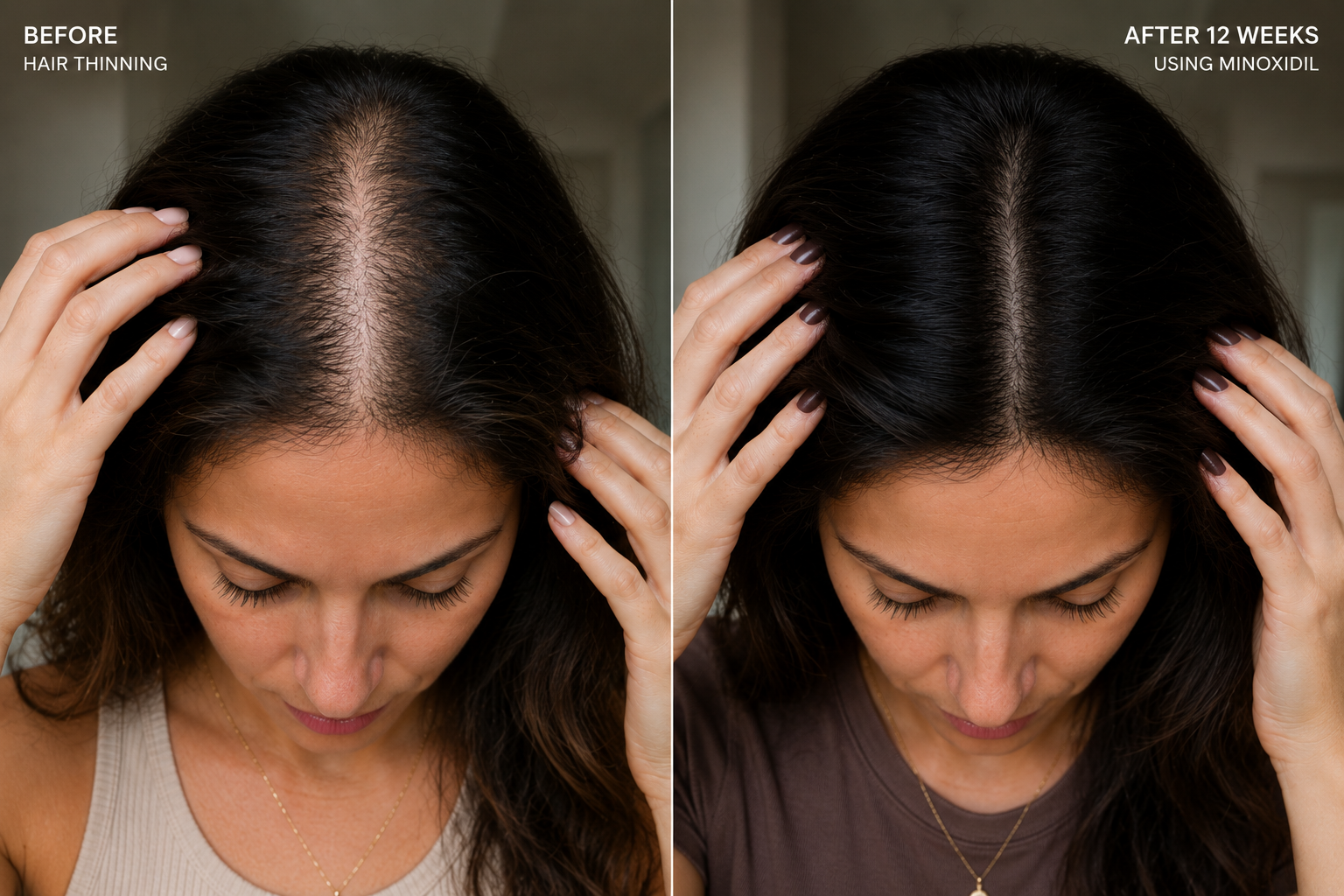
The short answer: Minoxidil is the most studied treatment for hair thinning in both women and men, and it works by prolonging the growth phase of your hair follicles and improving blood flow to the scalp. It comes as a topical foam or liquid you apply daily, or as a low-dose oral tablet prescribed off-label by a provider. Most people see reduced shedding within two to three months and visible density changes at four to six months, often after a brief, temporary shedding phase early on. It works best when you start early, stay consistent, and treat it as ongoing maintenance rather than a short course.
This guide is written with women in mind, because women's thinning is under-discussed and often mistreated with shampoos and supplements. But minoxidil is not a women's drug; it was approved for men first, and everything below about how it works, the shedding phase, and the timeline applies to men too. There's a section for men near the end.
Why women's hair thins differently than men's
Male hair loss usually shows up with a receding hairline and a bald crown. Women's hair loss is more subtle. It tends to show up as a part that's slowly gotten wider, a ponytail that feels thinner, more hair in the shower drain, or less volume at the crown, while the front hairline mostly stays put. Dermatologists call this female pattern hair loss, and it's the most common cause of thinning in women, affecting roughly 40 percent of women by age 50.
The triggers are also broader for women. Hormonal shifts around postpartum, perimenopause, and stopping birth control; thyroid changes; low iron or ferritin; rapid weight loss; high stress; and genetics can all play a role, sometimes together. That's why a provider review matters before treatment: minoxidil helps most kinds of thinning, but if low iron or a thyroid issue is driving it, you'll want that addressed too. If your hair feels like it's been through a rough season, our end-of-summer hair guide covers how to tell "bad hair week" from something worth treating.
How minoxidil actually works
Minoxidil was originally a blood pressure medication, and researchers noticed that patients on it grew more hair. It's now understood to work in a few ways at once. It widens blood vessels around the follicle, which improves nutrient delivery. It shortens the resting (telogen) phase and pushes follicles back into the growth (anagen) phase sooner. And over time, it enlarges miniaturized follicles so the hairs they produce are thicker and longer. It doesn't act on hormones, which is exactly why it works for women across the full range of causes, and why it works for men alongside a DHT-blocker rather than instead of one.
The shedding phase: what nobody warns you about
Two to eight weeks after starting minoxidil, many women notice more shedding, not less. This is expected and, counterintuitively, a good sign. Minoxidil pushes resting follicles into the growth phase, and the old hairs in those follicles get released to make room for new ones. The shed hairs were already on their way out. This phase typically lasts two to six weeks and then reverses. Knowing this in advance is the difference between sticking with treatment and quitting right before it starts working.
Side effects and who should be cautious
For topical minoxidil, the main issues are scalp irritation, dryness, or unwanted hair growth where the product drips onto the forehead or temples. For oral minoxidil, the most common side effect is hypertrichosis: fine hair growth on the face, arms, or back, which is dose-dependent and reverses when the dose is lowered or stopped. Less commonly, some people notice lightheadedness when standing, ankle swelling, or a faster heartbeat, all of which warrant a message to your provider. Oral minoxidil isn't appropriate for people with certain heart conditions, very low blood pressure, or who are pregnant or breastfeeding, and your provider will screen for these. Spironolactone shouldn't be taken during pregnancy, so reliable contraception is part of the conversation for women who could become pregnant.
What else helps alongside minoxidil
Minoxidil is the foundation, not the whole plan. Checking ferritin, vitamin D, and thyroid function catches the fixable contributors. Protein intake matters more than most people realize, especially if you're losing weight or on a GLP-1, since hair is a low priority for a body that's under-fueled. Gentle handling, fewer tight styles, and a heat-protectant help you keep the hair you're growing. And patience is a treatment in itself: hair grows about half an inch a month, so you're waiting for new growth to be long enough to make a visible difference.
For men: the same drug, a different plan
Everything above applies to men, with one difference in strategy. Men's pattern hair loss is driven mainly by DHT, and minoxidil doesn't touch DHT. So for men, minoxidil is the growth stimulator, and it works best paired with finasteride, which removes the hormonal cause. On its own, minoxidil helps men regrow at the crown but does less to stop the hairline from continuing to recede.
FORM's option for men is the Topical Hair Treatment, a compounded scalp formula combining minoxidil with ketoconazole and latanoprost, starting at $169 per month, and it pairs naturally with compounded finasteride at $89 per month. Our finasteride guide covers how the two work together and what the five-year data shows. Men who prefer a once-daily tablet over a topical can ask their provider about low-dose oral minoxidil, which is prescribed off-label for men at somewhat higher doses than for women.
Frequently asked questions
Does minoxidil work for women? Yes. Topical minoxidil is FDA-approved for women's hair loss, and low-dose oral minoxidil is widely prescribed off-label with strong published results. Most women see reduced shedding within two to three months and improved density by four to six months.
Is oral minoxidil better than topical for women? Both work. Oral minoxidil is easier to stick with, avoids scalp irritation and residue, and may work better for diffuse thinning, but it has a slightly different side effect profile and requires a prescription. Your provider can help you choose.
Why is my hair shedding more after starting minoxidil? Minoxidil pushes resting follicles into the growth phase, releasing old hairs first. This shedding typically starts two to eight weeks in, lasts a few weeks, and then reverses.
Will I grow facial hair on oral minoxidil? Some women notice fine hair on the face or body, especially at higher doses. It's the most common side effect and reverses when the dose is lowered or stopped.
What happens if I stop minoxidil? Hair gradually returns to the course it was on before treatment, usually over three to six months. Minoxidil is a maintenance treatment.
Does minoxidil work for men too? Yes. Minoxidil was approved for men first. For men, it works best paired with finasteride, since minoxidil stimulates growth but doesn't block the DHT that drives male pattern loss. FORM offers a topical minoxidil-based scalp treatment for men and compounded finasteride.
Can I use minoxidil while pregnant or breastfeeding? No. Minoxidil is not recommended during pregnancy or breastfeeding. Tell your provider if you're planning a pregnancy.