
How to Give Yourself an Injection at Home: A Step-by-Step Guide
If you've never given yourself a shot before, the first one can feel like a big deal. Most people find it's much easier than they expected — the needle is tiny, it goes just under the skin, and after a couple of tries the whole thing takes about a minute.
Here's exactly how to do it, start to finish.
One quick note: your pharmacy label and your FORM provider's instructions always come first. If anything here doesn't match what they told you, go with your provider.
What You'll Need
Your medication
A new syringe
Two alcohol pads
A cotton ball or gauze
A sharps container
Set everything out before you start, including the sharps container. It's much easier when you're not reaching for something mid-injection.
Where to Inject
These medications go into the layer of fat just under your skin. You have three good options:
Your belly. The easiest spot for most people, and usually the most comfortable. Stay at least two inches away from your belly button, and keep to the soft area rather than out toward your hip.
Your thigh. The front or outer side, in the middle section between your hip and knee. Easy to reach sitting down.
The back of your upper arm. This one works well, but it's hard to reach on yourself — it's really a spot for when someone else is giving you the injection.
Skip any area that's bruised, sore, red, scarred, or feels firm or lumpy, and avoid tattoos and stretch marks.
Move Your Spot Each Time
Use a slightly different spot with every injection — about a finger's width from the last one. You can stay in the same general area, just don't use the exact same place twice in a row.
This one's worth doing consistently. Injecting into the same spot over and over can cause the fat underneath to thicken, and medication doesn't absorb reliably through that tissue. Moving around keeps things working the way they should.
An easy way to keep track: picture your belly in four quarters and move to the next one each week.
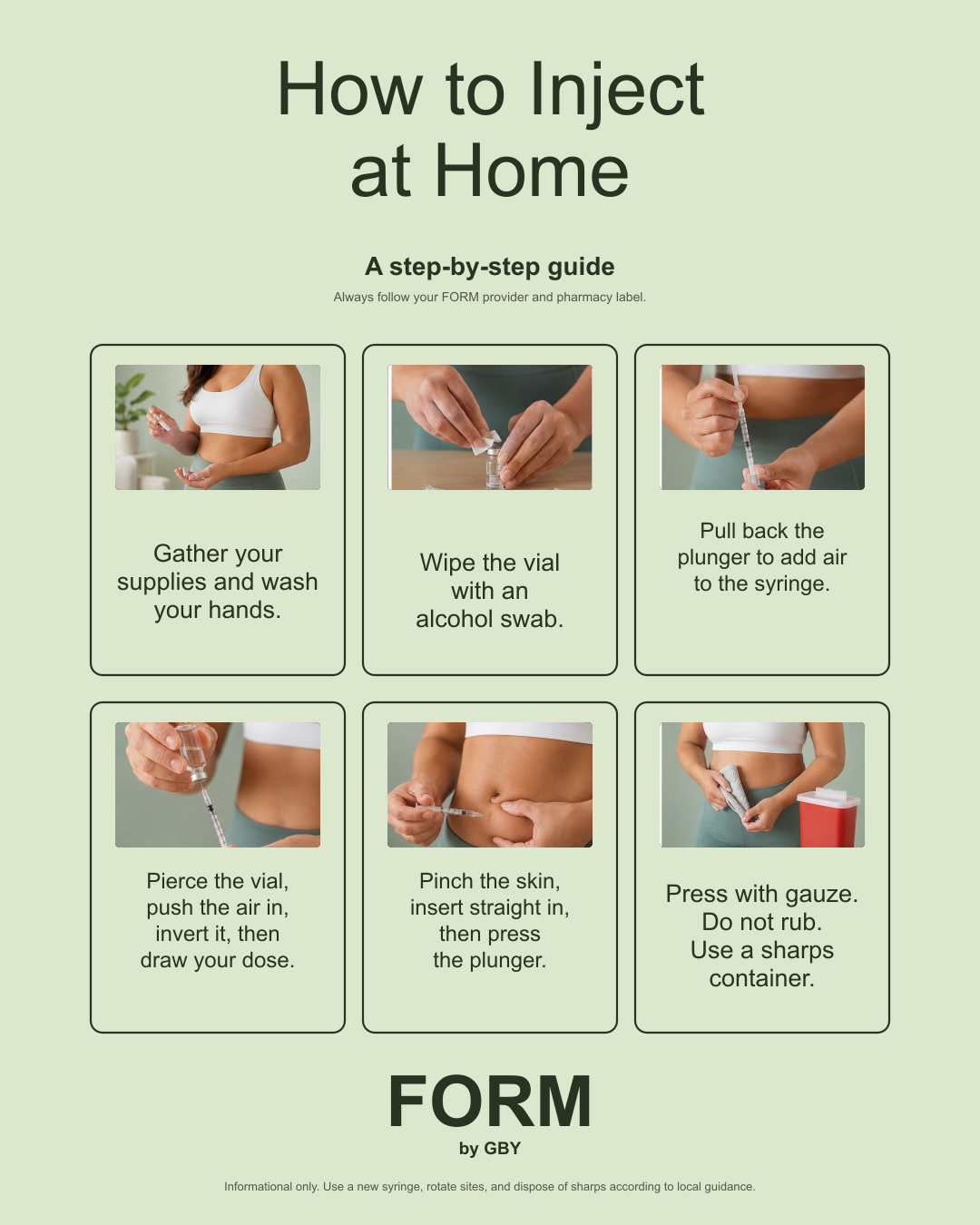
Step by Step
1. Take your medication out of the fridge
Give it 15 to 30 minutes to come to room temperature on the counter. Cold medication stings more going in, and this one small step makes a real difference in comfort. Don't try to speed it up with hot water or the microwave — just let it sit.
2. Wash your hands
Twenty seconds with soap and warm water, then lay out your supplies somewhere clean.
3. Check your dose
Look at your vial and confirm two things: the concentration printed on the label, and the exact marking on the syringe that equals your dose.
This is the step worth slowing down for. Concentrations can differ between pharmacies and can change between your own refills, so two vials that look identical might need different amounts on the syringe. Your dose in milligrams and your dose in syringe markings are two different numbers — make sure you know both.
If you're not completely sure which line on the syringe is yours, message your care team before you draw anything up. It takes a minute and it's the most useful question you can ask.
While you're looking at the vial, check that the liquid is clear and free of particles. If something looks off, don't use it — reach out to us instead.
4. Clean the vial and your skin
Wipe the rubber top of the vial with an alcohol pad. Pick your spot and wipe that with a second pad.
Let both dry completely before you go any further. Injecting through damp alcohol is the most common reason a shot stings unexpectedly.
5. Draw up your dose
Pull the plunger back to your dose marking so the syringe fills with that much air. Push the needle through the center of the rubber top and press the air in — this makes the medication much easier to draw.
Turn the vial upside down, keeping the needle tip below the liquid, and pull the plunger slowly to your marking.
If you see bubbles, tap the side of the syringe until they float to the top, push them back into the vial, and draw again. Check your marking one more time, then pull the needle out.
6. Give the injection
Pinch a fold of skin between your thumb and finger. Insert the needle in one smooth motion — quick is more comfortable than slow here, and hesitating tends to make it hurt more.
Most people inject straight in at 90 degrees. If you're very lean, your provider may have you go in at an angle instead.
Press the plunger down steadily until it stops, count to five, then pull the needle straight back out and let go of the pinch.
You can hold a cotton ball to the spot, but don't rub it. A tiny bit of blood or a small bruise is completely normal.
7. Put the syringe in your sharps container
Don't put the cap back on — just drop the whole syringe straight into the container.
If you don't have an official sharps container yet, the FDA says a heavy-duty plastic household container works in the meantime, like an empty laundry detergent bottle with a tight lid. What matters is that it's puncture-proof and closes securely.
Used needles shouldn't go in the regular trash or recycling, and never down the toilet. When your container is about three-quarters full, you can look up how to dispose of it where you live at safeneedledisposal.org.
Wash your hands, and you're done.
A Few Notes Depending on What You're Taking
If you're on a GLP-1
These are once-a-week injections. Pick a day and stick with it — you can inject at any time of day, with or without food.
If you need to switch which day you inject, check with your provider first, since the rules differ depending on which medication you're on.
If you miss a dose, don't double up. For semaglutide, take it as soon as you remember if your next dose is more than two days away — otherwise skip it and get back on schedule. For tirzepatide, you have about four days to take a missed dose before you skip it. If you've missed two or more in a row, message us; you may need to step back down and build your dose up again.
Some digestive side effects are common as you increase your dose — nausea especially, along with diarrhea, vomiting, or constipation. For most people this settles as the body adjusts to each new level. Let us know if it doesn't.
These medications go under the skin only — never into a vein or muscle.
If you're on a peptide
Same technique. Your schedule will be specific to you, so follow what your provider set rather than a general rule.
Some peptides arrive as a powder that you mix with a liquid we send along. If yours does, follow those mixing instructions exactly — the amount of liquid you add determines the strength, which determines how much you draw up. Swirl it gently to dissolve rather than shaking.
NAD+ can bring on a warm, flushing feeling while you inject. Going slower usually helps.
If you're on B12-MIC
Your B12-MIC is given subcutaneously, so the steps above are exactly what you'll follow — same sites, same technique, same rotation.
You may notice it's a smaller volume than other injections, which makes it a quick one. Follow the schedule your provider set for you, and rotate your spot each time just as you would with anything else.
Storing Your Medication
Your pharmacy label is the guide here — it has the storage instructions and the use-by date for your specific medication. A few general habits that help:
Keep it in the fridge unless you've been told otherwise, on a middle shelf rather than the door.
Never freeze it, and don't use anything that's been frozen.
Write the date on the vial the first time you use it.
Traveling? Pack it in your carry-on with a cold pack that isn't touching the vial directly.
If your medication has been sitting out or somewhere warm and you're not sure it's still good, just ask us.
What's Normal Afterward
A small red mark, a little itching, a pinpoint of blood, a light bruise, or some tenderness for a day — all normal and nothing to worry about.
Get in touch if you notice a lump that doesn't go away, redness that spreads, or a spot that gets more painful over a few days instead of less.
Seek emergency care right away for trouble breathing, swelling in your face, lips, or throat, a rash all over, or feeling faint. If you're on a GLP-1, severe stomach pain that won't let up — especially pain that goes through to your back — also needs immediate attention.
The Takeaway
Once you've done it a few times, giving yourself an injection stops feeling like an event. The habits that matter are simple: know your dose, use a new needle, move your spot each time, let the alcohol dry, and put the syringe straight into your sharps container.
And if anything comes up — a question about your dose, a lump that won't go away, or a shot you think went wrong — message your FORM provider. That's what we're here for.
This article is for informational purposes only and does not constitute medical advice. Always follow the instructions on your pharmacy label and the guidance of your licensed provider. Compounded medications are prepared for individual patients pursuant to a valid prescription and are not FDA-approved products; the FDA does not review them for safety, effectiveness, or quality. Dosing and storage details referenced here draw on the labeling for FDA-approved semaglutide and tirzepatide products and may differ from your compounded preparation.