
Weight Regain After Stopping Semaglutide: What Studies Show
One of the most searched questions about GLP-1 medications is not about starting them — it is about stopping. If you have lost weight on semaglutide, it is natural to wonder what happens if you come off it. The research gives a fairly clear answer, and while it is not always the answer people hope for, understanding it is the first step to planning well.

What the Research Found
The STEP 1 Trial Extension (Semaglutide)
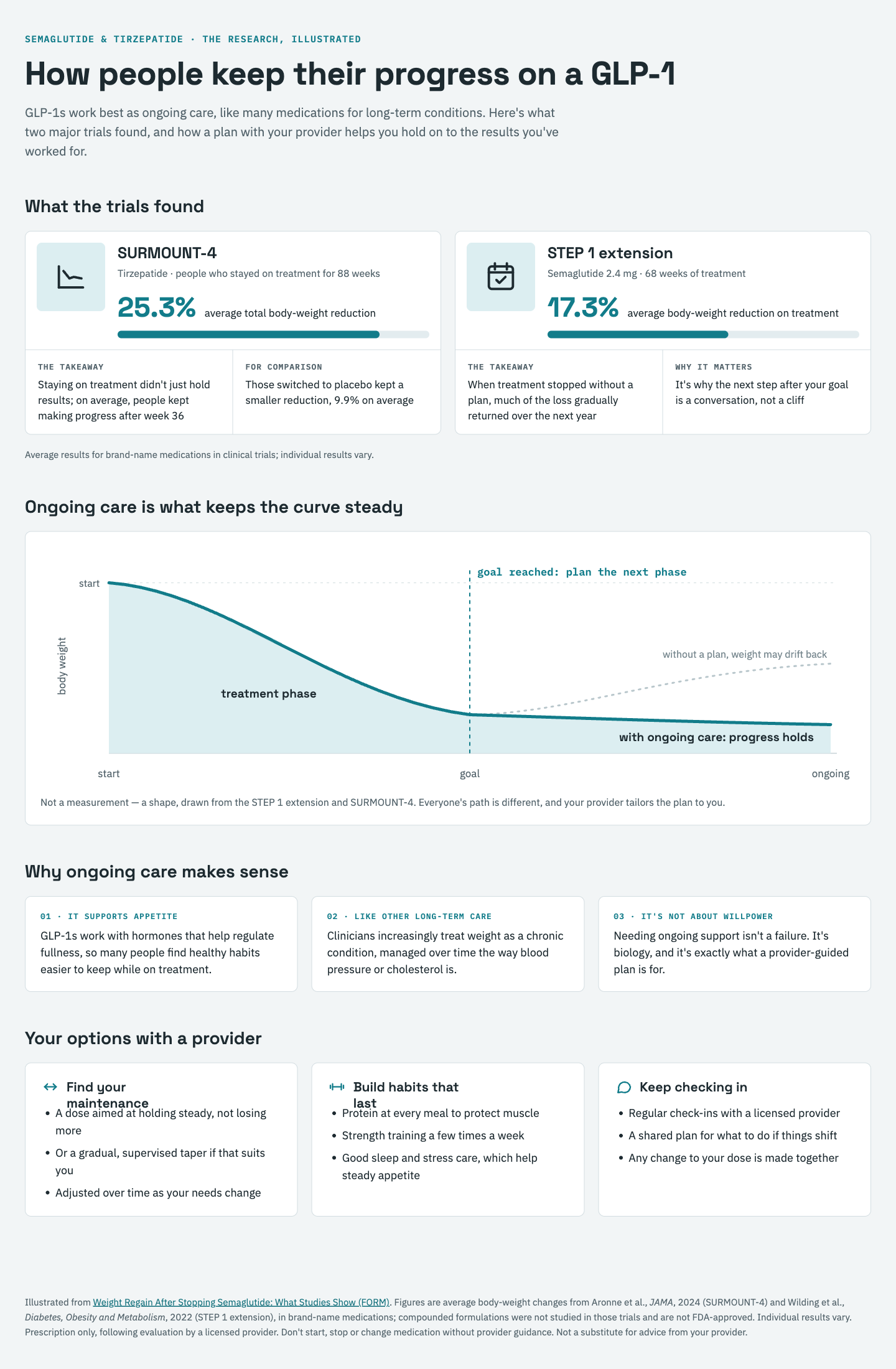
The best-known look at this question comes from an extension of STEP 1, a large trial of once-weekly semaglutide 2.4 mg (the dose used in Wegovy) in adults with obesity or overweight. After 68 weeks of treatment, a subset of participants stopped the medication and were followed for another year without it.
The finding: one year after stopping, participants had regained roughly two-thirds of the weight they had lost. On average, they were still below their starting weight — but much of the progress had reversed. Improvements in measures like blood pressure and waist circumference also largely moved back toward where they started as the weight returned. (Wilding et al., Diabetes, Obesity and Metabolism, 2022.)
SURMOUNT-4 (Tirzepatide)
A similar pattern showed up with tirzepatide. In SURMOUNT-4, adults took tirzepatide for 36 weeks, and then were randomly assigned either to keep taking it or to switch to placebo for another year. People who continued generally maintained or extended their loss; people switched to placebo regained a substantial share of it. A later analysis of the placebo group found most had regained more than a quarter of the weight they had lost within that year. (Aronne et al., JAMA, 2024.)
These are studies of specific brand-name medications under clinical-trial conditions. Individual experiences vary widely — but the direction of the findings is consistent across trials.
Why Weight Tends to Return
This is not a sign the medication "didn't work," and it is not a failure of willpower. GLP-1 medications work by mimicking hormones that help regulate appetite and fullness. When the medication stops, that support goes away — and for many people, appetite and "food noise" gradually return toward where they were before.
At the same time, the body tends to defend its previous weight. After weight loss, metabolism can slow and hunger signals can strengthen. This is why clinicians increasingly describe obesity as a chronic condition: the underlying biology does not disappear once the scale moves.
Not Everyone Regains the Same Amount
Averages hide a wide range. In the trials, some people regained very little while others regained most of their loss. Factors that may influence where someone lands include how long they were treated, how they stopped, and how established their nutrition, activity, and sleep habits were by the time they came off the medication. Research into which of these matters most is ongoing.
What This Means If You're Thinking About Stopping
The takeaway is not that you can never stop. It is that stopping is a decision worth planning with your provider rather than doing on your own. Paths people commonly discuss include:
Continuing at a maintenance dose aimed at holding weight steady rather than continuing to lose.
A gradual, supervised taper rather than stopping abruptly, with close attention to how appetite responds.
Reinforcing the fundamentals before and during any change — protein, resistance training, sleep, and stress — because they carry more of the load once medication support is reduced.
A plan for what happens if weight starts to return, agreed on in advance.
Protecting Muscle Matters, Too
Some of the weight lost on any weight-loss treatment can come from lean muscle, and muscle plays a big role in long-term metabolism. Strength training and adequate protein during treatment help protect muscle — and give you a stronger base if your plan changes later.
Questions to Ask Your Provider
Based on my progress, does a maintenance dose or a taper make more sense?
What signs should prompt us to adjust the plan?
How often will we check in during and after any change?
What should I be doing now, on the medication, to make maintenance easier later?
The FORM Perspective
At FORM by GBY, care is provider-guided and ongoing, which means the question "what happens if I stop?" is one you get to answer with a licensed provider, on your timeline, with a plan. If you are on a GLP-1 and thinking about next steps, start or revisit your FORM intake and build a maintenance plan that’s right for you.
This article is for general educational purposes only and does not constitute medical advice. Study results describe specific brand-name medications in clinical trials and do not predict individual outcomes. Compounded medications are not FDA-approved and are not the same as brand-name products. GLP-1 medications require evaluation and ongoing management by a licensed healthcare provider. Do not stop or change your medication without provider guidance.